
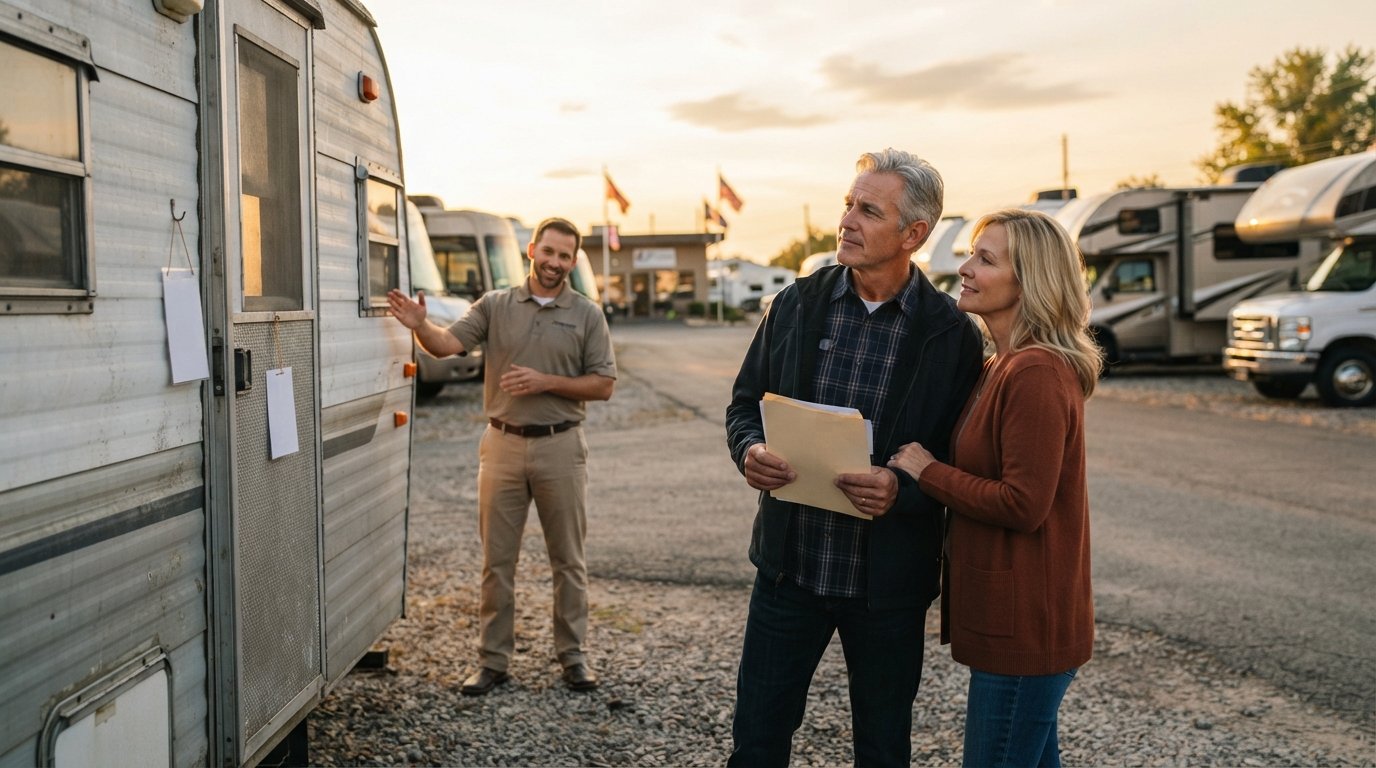
How Hard Is It to Finance an RV With Bad Credit?
Financing an RV with bad credit is harder but doable. Learn how down payments, lender choice, and income proof can offset a low score and get you approved.

By Kevin Thompson
Dreaming of hitting the open road in a recreational vehicle does not disappear because your credit score has taken a few hits. The real question is not whether you can buy an RV, but how much extra work and money it will take to get there. The short answer: financing an RV with bad credit is harder than financing one with good credit, but it is far from impossible. Lenders who specialize in subprime or nonprime loans exist, and they evaluate more than just your three-digit score. They look at income, down payment, and the type of RV you want to buy. Understanding those levers puts you back in control.
Why RV Lending Is a Different Animal
RV loans are not the same as car loans. Many banks and credit unions treat them as recreational or luxury purchases, which means stricter underwriting and higher credit score minimums. A conventional RV lender might want a score of 700 or better for the best rates. With bad credit, you fall outside that box, and traditional lenders may decline you outright. That does not mean the door is closed, but it does mean you need to know where to knock.
The size and type of RV matter just as much as your credit. A $15,000 used travel trailer is a much easier approval than a $150,000 Class A motorhome. Lenders see the motorhome as a depreciating luxury asset with a complex title, while a small trailer is closer to a standard vehicle loan. If your credit is weak, starting with a lower-priced unit dramatically improves your odds.
There is also the question of collateral and loan terms. RV loans can stretch to 10, 15, or even 20 years, which lowers the monthly payment but increases total interest. With bad credit, expect shorter terms and higher rates, because the lender is taking on more risk. That combination can push monthly payments higher than you expect. Running the numbers before you shop is essential, not optional.
How Bad Credit Affects Your RV Loan Options
Bad credit does not have one definition. A score of 580 is very different from a score of 480. Lenders typically bucket borrowers into tiers, and each tier carries its own rate range and down payment requirement. The lower your score, the more money you will need upfront and the higher your interest rate will climb. That is the core trade-off: bad credit costs you more, both at signing and over the life of the loan.
Here is a realistic breakdown of what changes when your credit is bruised:
- Higher interest rates: You might see rates several percentage points above prime, which can add thousands in finance charges.
- Larger down payment: Many subprime RV lenders want 10 to 20 percent down, sometimes more for larger units.
- Stricter income verification: Lenders want to see stable, provable income that comfortably covers the payment.
- Shorter loan terms: Instead of 15 years, you might be offered 5 to 10 years, raising the monthly obligation.
- Fewer lender choices: Banks may say no, leaving you with specialty lenders or dealer-arranged financing.
These hurdles are real, but they are predictable. Once you know the pattern, you can prepare for it. A larger down payment and a smaller, used RV can offset much of the credit penalty. So can a co-borrower with better credit, if that is an option you are comfortable exploring.
Where to Look for an RV Loan With Bad Credit
Traditional banks are usually the first stop for RV buyers, and they are also the first to say no when credit is rough. Credit unions can be more flexible, especially if you have an existing relationship, but they still lean conservative on recreational loans. The most realistic path for bad credit is specialty lenders and dealer-arranged financing, both of which are built around higher-risk borrowers.
Online connection services have changed the game here. Instead of applying to ten lenders one by one, you can submit a single request and get matched with participating dealers and lenders who work with bad credit. StartAutoLoan.com is one such platform: it is a connection service, not a direct lender, and it focuses on borrowers who have been turned away elsewhere. The application takes minutes, and you can request options for new, used, and refinance loans. If you want to understand the broader approval landscape first, our guide on auto loans with bad credit walks through the same principles that apply to RVs.
Dealer financing is another strong option, particularly for used RVs sold through dealerships that work with subprime buyers. The dealer has a financial incentive to get you approved, and they often have relationships with lenders that do not advertise to the public. The trade-off is that you may pay a higher rate or see add-ons baked into the deal, so read every line of the contract.
Steps to Improve Your Approval Odds
Before you fill out a single application, take a hard look at your financial picture. Lenders care about three things: your credit history, your income, and your down payment. You cannot rewrite the past, but you can strengthen the other two. A bigger down payment reduces the lender's risk, and stable income proves you can handle the payment. Together, they can outweigh a low score.
Follow this sequence to put yourself in the best position:
- Pull your credit reports and fix errors. Dispute anything inaccurate, and pay down balances to lower your utilization ratio.
- Save for a down payment of at least 10 to 20 percent. On a $30,000 RV, that is $3,000 to $6,000, and it can be the difference between approval and denial.
- Gather proof of income and bank statements. Lenders want to see consistent deposits, not just a pay stub.
- Consider a co-borrower. Someone with better credit can boost the application, though it ties them to the loan.
- Apply through a connection service or dealer network. This lets multiple lenders review your profile without multiple hard pulls on your credit.
One more step that many buyers overlook: get preapproved before you shop. Preapproval tells you your budget and gives you leverage at the dealership. It also prevents the emotional trap of falling in love with an RV you cannot finance. If you are also weighing a standard vehicle purchase, the same preapproval logic applies to auto title loan alternatives and vehicle financing options that help borrowers with damaged credit find a path forward.
What It Will Actually Cost You
Numbers make the difficulty concrete. Suppose you finance a $40,000 used RV. With good credit, you might qualify for a 7 percent rate over 10 years, which works out to roughly $464 per month and about $15,700 in total interest. With bad credit, that same loan might carry a 15 percent rate, pushing the payment to about $646 per month and total interest to nearly $37,500. The RV is identical. The credit profile changes everything.
That gap is why down payments matter so much. If you put 20 percent down on that $40,000 RV, you are financing $32,000 instead of $40,000. At 15 percent over 10 years, the payment drops to about $517, and total interest falls to roughly $30,000. You save both monthly cash flow and long-term cost. A larger down payment is the single most effective tool a bad-credit buyer has.
Do not forget the ancillary costs. RVs need insurance, storage, maintenance, and fuel, and those expenses do not care about your credit score. Lenders will factor a debt-to-income ratio that includes the new payment, so a realistic budget must account for everything, not just the loan. Buyers who stretch to make the payment often end up missing it later, which digs the credit hole deeper.
Common Mistakes That Sink Bad-Credit RV Applications
The fastest way to get denied is to apply everywhere at once. Each application can trigger a hard inquiry, and a cluster of them makes you look desperate to lenders. Use a connection service that submits your profile to multiple lenders through a single request, or stick to one or two targeted applications. Rate shopping within a short window is generally treated as a single inquiry by scoring models, but that window is narrow.
Another common mistake is overstating income or leaving out debts. Lenders verify everything, and a mismatch between your application and your documents is an automatic red flag. Be honest and conservative. If your income is variable, document it thoroughly and consider a smaller loan that fits your worst month, not your best.
Finally, do not ignore the type of RV. A lender may approve you for a travel trailer but decline a motorhome because of the title complexity and resale risk. If you have your heart set on a motorhome, be prepared for a larger down payment and a higher rate. If you are flexible, a used trailer or fifth wheel is the easier approval and a smarter first step into RV ownership.
The Bottom Line on Difficulty
Financing an RV with bad credit is harder than financing one with good credit, but it is not the wall it appears to be. The difficulty shows up as higher rates, bigger down payments, and fewer lender choices, not as a flat no. Borrowers who plan ahead, save aggressively, and use the right channels can and do get approved every day. The key is to treat bad credit as a pricing problem, not a disqualification.
Start by checking your credit, saving what you can, and applying through a service that works with subprime borrowers. Be realistic about the RV you can afford, and read every contract before you sign. The open road is still within reach; it just takes a more deliberate route to get there.