
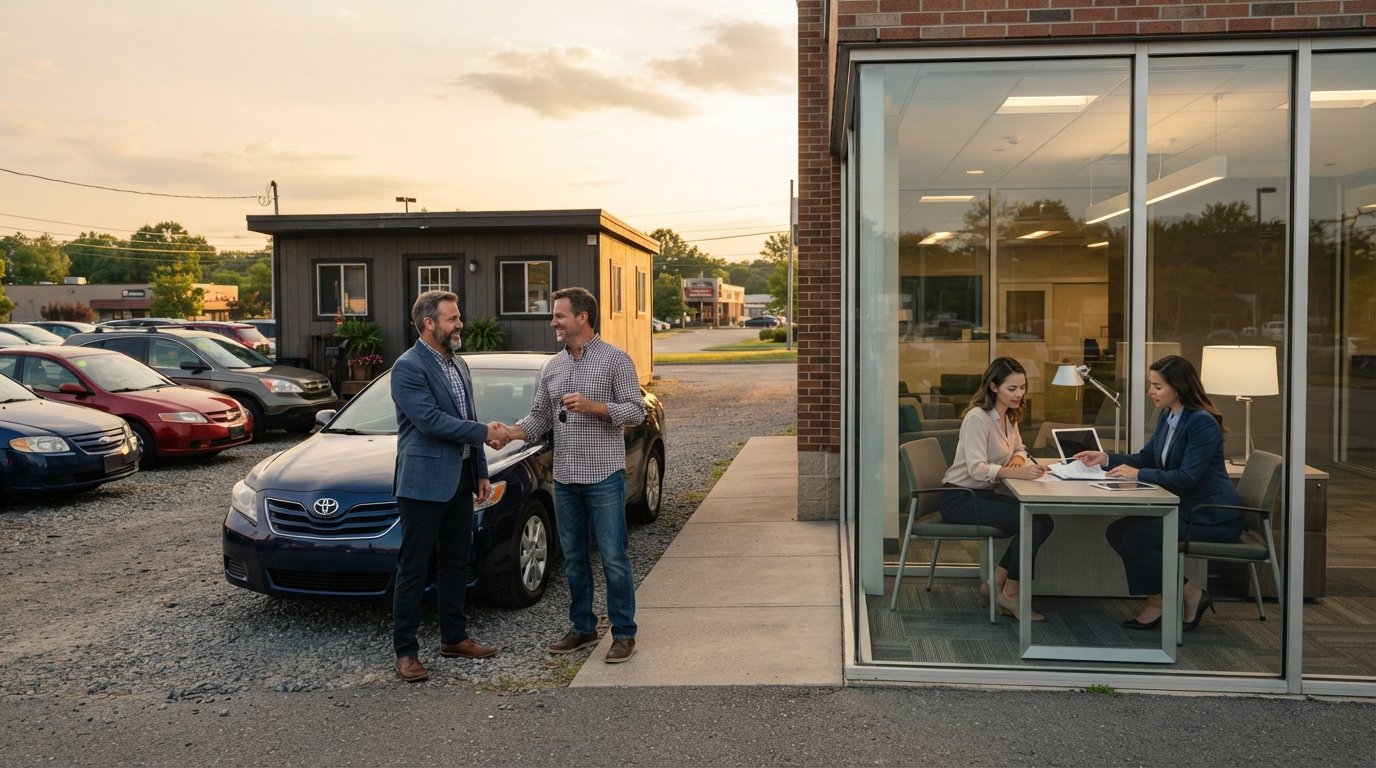
Buy Here Pay Here Versus Traditional Auto Loan After Bad Credit
Compare buy here pay here versus traditional auto loan after bad credit, including rates, credit reporting, and which option saves you more money.

By Nicole Thompson
If your credit score has taken a hit, walking into a dealership or bank can feel like a dead end. You need a car to get to work, to take your kids to school, or to simply keep your life moving, yet traditional lenders keep saying no. That frustration is exactly why so many buyers with damaged credit start weighing buy here pay here versus a traditional auto loan after bad credit. One path promises instant approval and a quick drive home, while the other offers lower rates but a tougher application process. Understanding how each option really works, including the hidden costs and the long term impact on your finances, can save you thousands of dollars and a lot of stress.
What Is Buy Here Pay Here Financing?
Buy here pay here, often shortened to BHPH, is a financing model where the dealership that sells you the car also acts as the lender. Instead of sending your application to a bank or credit union, the dealer reviews your income, your down payment, and sometimes your references, then decides whether to finance the vehicle on the spot. Because the dealer carries the risk, credit score requirements are far looser than what you would find at a traditional lender. Many BHPH lots advertise that no credit check is required at all.
The trade off is significant. BHPH dealers typically charge higher interest rates, sometimes ranging from 18 percent to 29 percent or more, and they often require a substantial down payment. The vehicles on these lots also tend to be older and higher mileage, which means you may face more repair bills during the loan term. Payments are usually collected weekly or biweekly, either in person or through an electronic tracking device installed on the car. If you miss a payment, the dealer can disable the vehicle or repossess it quickly, sometimes without the legal notice a bank would provide.
That said, BHPH lots do serve a purpose. They give people with severe credit challenges, including recent bankruptcies or collections, a way to get transportation when no one else will approve them. The key is going in with clear eyes about what you are signing. Before committing, it helps to estimate what a realistic monthly payment looks like for your budget. Our guide on the auto payment estimator walks through the math so you can compare offers without guessing.
How Traditional Auto Loans Work After Bad Credit
A traditional auto loan comes from a bank, credit union, or online lender. The lender evaluates your credit history, income, debt to income ratio, and the vehicle itself before deciding on approval and terms. When your credit is damaged, this process becomes harder, but it is not impossible. Many lenders specialize in subprime auto financing, which means they work with borrowers who have scores below 600. Credit unions in particular can be more flexible because they are member owned and may weigh your relationship with them alongside your score.
The biggest advantage of a traditional loan is cost. Even a subprime loan from a bank or credit union often carries a lower interest rate than a BHPH contract. You also build positive payment history that reports to the major credit bureaus, which can help your score recover over time. Traditional lenders usually report to all three bureaus, while many BHPH dealers report to none or only one. That difference matters enormously if your goal is to rebuild credit and eventually refinance into a better loan.
Traditional financing does come with more hoops. You will need to provide proof of income, proof of residence, a valid driver license, and sometimes a down payment of 10 to 20 percent. The approval process can take a day or longer, and you may need to shop around to find a lender willing to work with your credit profile. Still, the effort often pays off in the form of lower monthly payments and a loan that actually helps you move forward financially.
Key Differences Between Buy Here Pay Here and Traditional Auto Loans
The two financing paths differ in nearly every way that matters to your wallet. Understanding these differences side by side makes it easier to choose the right option for your situation. Here are the main points of comparison that buyers with bad credit should weigh carefully.
- Approval standards: BHPH dealers focus on income and down payment, while traditional lenders review credit scores, payment history, and debt ratios.
- Interest rates: BHPH rates frequently exceed 20 percent, while subprime traditional loans often range from 10 to 18 percent depending on the lender and term.
- Credit reporting: Most BHPH dealers do not report to the credit bureaus, so on time payments may not help your score, whereas traditional lenders almost always report.
- Vehicle quality: BHPH inventory tends to be older and higher mileage, while traditional financing gives you access to newer, more reliable cars.
- Repossession rules: BHPH dealers can act faster and with fewer legal protections for the borrower, while banks must follow stricter state and federal guidelines.
The credit reporting difference is the one that catches most people off guard. If you make 24 on time payments to a BHPH dealer that does not report, you finish the loan with no stronger credit profile than when you started. A traditional loan, even at a higher subprime rate, gives you a documented payment history that future lenders can see. That history is what unlocks better rates on your next car, a mortgage, or even a credit card.
The Real Cost of Buy Here Pay Here Financing
To see why the financing choice matters so much, consider a concrete example. Suppose you buy a $10,000 car. A traditional subprime lender approves you at 14 percent interest for 60 months, which produces a monthly payment of about $233 and total interest of roughly $3,980. A BHPH dealer finances the same car at 24 percent for 48 months, which produces a monthly payment of about $325 and total interest of roughly $5,600. You pay more each month, finish sooner only because the term is shorter, and end up spending nearly $1,600 more in interest alone.
That gap widens when you factor in the down payment. BHPH dealers often ask for $1,000 to $3,000 down, sometimes more, while traditional subprime loans may require 10 percent down or none at all for qualified buyers. Add in the higher likelihood of repairs on an older BHPH vehicle, and the true cost of buy here pay here can easily exceed the sticker price by several thousand dollars. None of this means BHPH is always wrong. If it is your only path to a reliable car and you have no other options, it can be a bridge. But you should treat it as a short term solution, not a long term plan.
When Buy Here Pay Here Makes Sense
There are situations where BHPH is the most practical choice. If your credit is severely damaged, you have a recent repossession or bankruptcy, and you need a car immediately to keep a job or care for family, a BHPH lot may be the only door that opens. The same is true if you have no credit history at all and no co signer, since traditional lenders may decline you without a score to evaluate.
BHPH can also work if you go in with a plan. Buy the cheapest reliable car you can find, make every payment on time, and save aggressively for a down payment on a better vehicle. Keep the loan term as short as possible to limit interest, and get a pre purchase inspection from an independent mechanic so you do not inherit a money pit. If the dealer will not allow an inspection, walk away. A legitimate seller should have nothing to hide.
It also helps to check whether the dealer reports to at least one credit bureau. Some BHPH operations do report, and those are far more valuable to you because your payments build a record. Ask before you sign. If the answer is no, ask yourself whether the car is worth the cost without any credit benefit.
When a Traditional Auto Loan Is the Better Path
If you have any ability to qualify for traditional financing, even at a subprime rate, it is usually the stronger choice. The lower interest rate, the credit reporting, and the access to better vehicles all work in your favor. The challenge is getting approved. That is where working with a connection service can help. StartAutoLoan.com is an independent online platform that matches borrowers with a network of participating lenders and dealers who work with bad credit, no credit, and past bankruptcies. Instead of applying at one bank and getting rejected, you submit one request and let multiple financing sources compete for your business.
The platform is not a lender itself, and it does not promise approval. What it does is widen your options so you can compare offers and choose the one with the lowest rate and best terms. That comparison is exactly what protects you from overpaying. For borrowers who have been turned down elsewhere, having several lenders review the same application can be the difference between a 22 percent loan and a 14 percent loan, which translates into thousands of dollars saved over the life of the loan.
If you already have a car loan with a high rate, refinancing may be another route. Companies like CarLoanRefinancing provide educational resources and connect vehicle owners with lending partners who may offer lower rates or adjusted terms. Refinancing does not erase bad credit, but it can reduce your monthly payment and total interest if your credit has improved since you originally financed the car.
How to Choose the Right Option for Your Situation
The decision comes down to your credit profile, your timeline, and your budget. If you have weeks to shop and any shot at traditional approval, start there. If you need a car this week and traditional lenders have already said no, BHPH may be your fallback. Either way, follow a few practical steps to protect yourself.
- Check your credit reports for free at AnnualCreditReport.com and dispute any errors before you apply anywhere.
- Get preapproved or prequalified with at least two traditional lenders, including a credit union, so you know your real rate range.
- Compare the total cost of each offer, not just the monthly payment, by multiplying the payment by the number of months and adding the down payment.
- Insist on an independent mechanic inspection for any used car, especially at a BHPH lot.
- Read every contract line, including late fees, repossession triggers, and whether payments are reported to the credit bureaus.
If you decide to pursue traditional or subprime financing, StartAutoLoan.com can streamline the process. You can request auto financing options in your area and get connected with dealers and lenders who are set up to work with less than perfect credit. The service is free to use, and there is no obligation to accept any offer you receive.
Building Credit After You Buy
Whichever route you take, the loan is only the beginning. The way you manage it determines what your credit looks like in two or three years. Make every payment on time, keep the loan term as short as you can afford, and avoid taking on new debt while you are rebuilding. If you financed through a BHPH dealer that does not report, consider opening a secured credit card or a credit builder loan to create a positive payment history on your report.
Once you have 12 to 18 months of on time payments, check your credit score and explore refinancing. A lower rate on the same car can free up hundreds of dollars a month and shorten your payoff timeline. The goal is to turn a bad credit auto loan into a stepping stone, not a trap. With patience and a clear plan, the financing you choose today can help you qualify for better terms tomorrow.
Bad credit does not have to mean a permanent dead end. It means you need to be more careful about where you borrow, what you sign, and how you manage the loan afterward. Whether you go with buy here pay here or a traditional auto loan, the smartest move is to gather multiple offers, read the fine print, and treat the loan as a tool for rebuilding rather than a final destination.